aws security - last min rev
AWS ACM: A service to manage certificates for AWS services, simplifying their use and renewal.
AWS Identity Management Services:
- AWS SSO: Centralizes SSO access to AWS accounts.
- Amazon Cognito: Manages user authentication for apps.
- AWS IAM: Controls access to AWS resources using policies.
IAM is free and global, not region-specific.
Types of firewall in EC2
In EC2, there are two main types of firewalls:
- Security Groups: Act as virtual firewalls for EC2 instances to control inbound and outbound traffic. They are stateful, meaning if you allow inbound traffic, the response is automatically allowed.
- Network Access Control Lists (NACLs): Operate at the subnet level, controlling inbound and outbound traffic for all instances within a subnet. They are stateless, meaning responses must be explicitly allowed.
Prevention in security Lifecycle

AWS System Manager Inventory Function ss

The AWS Systems Manager inventory function offers centralized management, detailed instance inventory, automation for tasks like software and patch management, enhanced security through up-to-date instance information, and operational insights for improved efficiency within AWS environments.
Types of prevention measures (Onion layers)

OSI MODEL
- Layers: Physical
- Data link
- Network,
- Transport,
- Session,
- Presentation,
- Application.
WHICH THREE TASKS ARE PERFORMED AT THE PREVENTION PHASE OF SECURITY LIFE CYCLE
- Identify assets to be protected
- Assess asset vulnerability
- implement countermeasures
Network Hardening
- Prevents unauthorized access, misuse, and data breaches.
- Two Types:
- Discovery Hardening – Blocks network mapping.
- Architecture Hardening – Secures design.
Threats & Prevention
- Network Mapping (ping, traceroute, Nmap) – Disable ICMP, SNMP.
- Port Scanning (Nmap) – Monitor & limit access.
- Traffic Sniffing (Wireshark) – Encrypt data, use switches.
- AWS: Use Amazon Inspector for vulnerabilities.
Architecture Hardening
- Firewalls – Deny all by default.
- IPS – Blocks threats (AWS Network Firewall).
- Segmentation – Uses CIDR & ACLs for subnet security.
AWS Security
- Security Groups – Instance-level, stateful.
- Network ACLs – Subnet-level, stateless.
- Layered security for VPCs.
🔹 Focus: Block threats, encrypt data, limit access, monitor traffic.
- AWS Systems Manager: Focused on managing and automating tasks on AWS resources (e.g., patching, inventory, secure shell access).
- Amazon CloudWatch: Provides real-time monitoring of AWS resources and applications (e.g., performance metrics and logs).
- AWS CloudTrail: Tracks all API and console actions in AWS for auditing and compliance.
Key Difference:
- Systems Manager = Manage resources.
- CloudWatch = Monitor resources.
- CloudTrail = Track actions on resources.
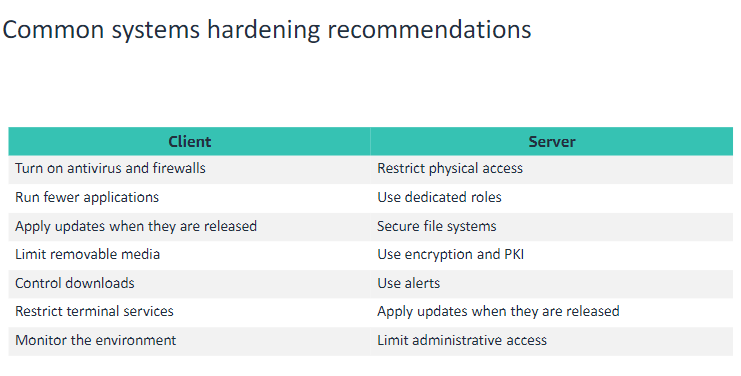
System hardening
- Goal: Secure systems by reducing vulnerabilities while balancing usability and productivity.
- Core Principles: Focus on authentication, authorization, and accounting.
- Key Steps:
- Disable unnecessary services.
- Apply patches and updates regularly.
- Establish security baselines to detect anomalies.
- Use group policies for centralized control.
- Types of Hardening:
- Server Hardening: Secure data, ports, and permissions.
- Application Hardening: Update security measures for standard and third-party apps.
- Mobile Device Management (MDM): Secure BYOD environments.
For securing mobile devices, use a mobile device management (MDM) solution. Use MDM to enforce corporate and security policies regarding the use of devices. Companies that permit bring your own device (BYOD) should implement MDM
- Physical Security: Restrict access, use surveillance, and design disaster-resistant facilities.
- AWS Tools:
- Trusted Advisor: Best practice recommendations.
- GuardDuty: Threat detection using machine learning.
- Shield: DDoS protection.
- CloudTrail: Tracks user activity for auditing.
- Training: Educate employees to combat social engineering and phishing.
- Key Takeaway: Harden systems by minimizing attack surfaces, applying patches, and using tools like AWS for automated security management.
| Feature | AWS Trusted Advisor | Amazon GuardDuty | AWS Shield | AWS CloudTrail |
|---|---|---|---|---|
| Purpose | Provides recommendations for best practices in security, performance, cost, and fault tolerance. | Detects threats using machine learning, anomaly detection, and threat intelligence. | Protects against DDoS attacks. | Tracks user activity and API calls for auditing and security. |
| Function | Identifies security gaps and optimizes AWS resources. | Monitors AWS accounts, workloads, and network activity for suspicious behavior. | Defends applications against large-scale DDoS attacks. | Logs AWS API calls for governance, compliance, and debugging. |
| Focus Area | Security, cost optimization, performance, and resilience. | Threat detection and anomaly identification. | DDoS mitigation and network protection. | User activity tracking and audit logs. |
| Detection & Prevention | Preventative – Helps improve AWS configurations proactively. | Detects ongoing security threats and alerts users. | Mitigates DDoS attacks in real-time. | Provides logs for post-incident analysis but does not actively prevent attacks. |
| Threat Handling | No direct threat detection, only best-practice suggestions. | Identifies threats such as compromised instances, credential theft, and malicious activities. | Shields against volumetric, state-exhaustion, and application-layer DDoS attacks. | Records actions for forensic investigation and compliance. |
| AWS Services Monitored | AWS resources (EC2, RDS, IAM, S3, etc.). | VPC Flow Logs, CloudTrail logs, and DNS logs. | AWS applications and networks. | All AWS API calls across accounts. |
| Use Case | Optimize AWS resource security, cost, and performance. | Identify security breaches, unauthorized access, and malicious activity. | Protect against DDoS attacks on AWS-hosted applications. | Audit AWS activity and detect policy violations. |
PREVENTION - DATA SECURITY
CIA Triad: Confidentiality (protect data), Integrity (prevent tampering), Availability (ensure access).
Encryption
- Symmetric: Same key for encryption & decryption. Fast, used for large data (AES, IDEA, Twofish).
- Asymmetric: Public & private key pair. More secure, slower (RSA, DH, ElGamal).
- Hybrid: Uses asymmetric for key exchange, symmetric for bulk data (TLS, secure messaging).
AWS Encryption Services
- CloudHSM: Hardware security module for key management & compliance.
- AWS KMS: Fully managed cryptographic key service, integrates with AWS.
PREVENTION - PUBLIC KEY INFRASTRUCTURE
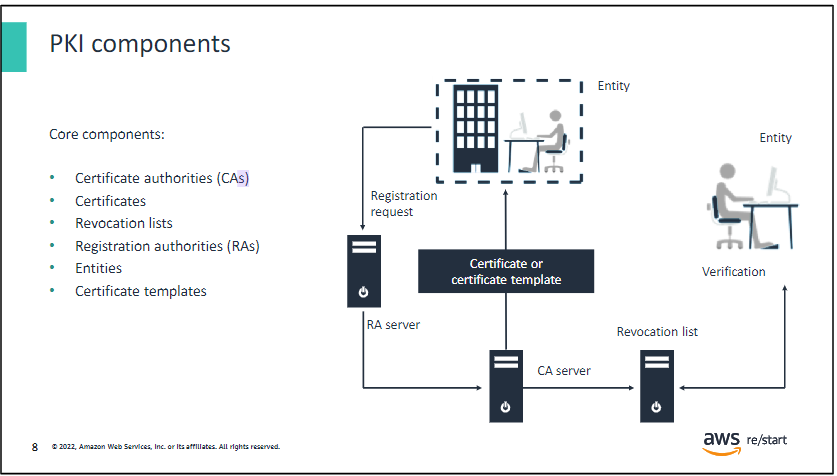
Public key infrastructure (PKI) is a collection of technologies that are used to apply cryptography principles to transfer information securely between two entities. It is based on a practical distribution and implementation of keys, with a set of tools to achieve confidentiality, integrity, non-repudiation, and authenticity
Components:
- Certificate Authority (CA): Issues and manages digital certificates.
- Registration Authority (RA): Verifies certificate requests before CA approval.
- Certificate Revocation List (CRL): A list of revoked certificates.
- Online Certificate Status Protocol (OCSP): Used to check if a certificate is revoked in real time.
- Certificates: Digital IDs proving ownership of public keys.
How it Works: A user requests a certificate from RA, which passes it to CA. After verification, CA issues the certificate.
ACM - AWS Certificate Manager : A service to manage certificates for AWS services, simplifying their use and renewal.
PREVENTION - IDENTITY MANAGEMENT
AAA Principles:
- Authentication: Verifying identity (e.g., password, ID).
- Authorization: Granting access based on identity.
- Accounting: Tracking user actions (e.g., login logs).
AWS Identity Management Services:
- AWS SSO: Centralizes SSO access to AWS accounts.
- Amazon Cognito: Manages user authentication for apps.
- AWS IAM: Controls access to AWS resources using policies.
4. PREVENTION - IDENTITY AND ACCESS MANAGEMENT (AWS)
- IAM Overview: Manages access to AWS resources (authentication and authorization). It’s free and global.
- Components:
- Users: Person/application with credentials and permissions.
- Groups: Collections of users for easier permission management.
- Roles: Provide temporary access to resources and avoid long-term credentials.
- Security Credentials: Includes IAM username/password, access keys, MFA, and key pairs. Avoid using root for daily tasks, enable MFA for extra security.
- Authentication & Authorization: IAM policies define resource access and actions; explicit deny takes precedence.
- IAM Policies:
- Managed Policies: Standalone policies.
- Inline Policies: Embedded into a user/group/role.
- Access Control: Actions are denied by default, with policies allowing or denying access.
- Access to AWS Services: Access AWS services through Console, CLI, SDKs, and APIs.